How Much Does Weight Fluctuate in a Day? What's Normal
By The Periscope Team · · 6 min read
Weight typically changes by a few pounds within a day and by 1 to 3 pounds from one morning to the next. Almost all of it is water, stored carbohydrate and food still in your gut, not fat. Gaining a pound of fat takes thousands of extra calories, so judge progress by a trend over weeks, not one reading.
Key takeaways
- In one man weighed under identical conditions for 9,521 days, the typical day-to-day change was about 0.5% of body weight, roughly 1 pound at 180 pounds.
- You weigh more in the evening than in the morning because food and drink have weight until they're used or passed; a liter of water alone is 2.2 pounds.
- Each gram of stored carbohydrate (glycogen) is held with at least 3 grams of water, so a high-carb day often shows up on the scale the next morning.
- A weekly average or smoothed trend line cancels out most of the noise and shows which way your weight is really moving.
- Fast gain with swelling in your legs or ankles, or with shortness of breath, is a reason to call a doctor rather than wait.
In this article
General information, not medical advice. If something about your weight worries you, talk to a doctor. How we write these articles
How much weight fluctuates in a day surprises most people: a few pounds between morning and evening is normal, and 1 to 3 pounds between one morning and the next is common. Almost none of it is fat. It's water, stored carbohydrate and whatever is still working its way through your gut.
That's why a single weigh-in tells you so little. A smoothed number, often called trend weight, is far more useful. If you already have a few weeks of weigh-ins, you can calculate your trend weight in a minute and see what the noise is hiding.
How much does weight fluctuate in a day?
Morning to evening, expect to be heavier by roughly the weight of what you've eaten and drunk that hasn't been used or passed yet. That's often a few pounds. A liter of water weighs 1 kg (2.2 lb), so a couple of big glasses of water with dinner adds a pound before you count the food. Overnight you lose some of it again through breathing, sweat and the morning bathroom trip.
There's surprisingly little published research on morning-versus-evening weight in ordinary people, so treat any precise figure you see online with care. The practical answer is simpler: weigh at the same time each day, ideally first thing in the morning, and the within-day swing stops mattering.
Between mornings, the best data comes from one man who weighed himself every morning for almost 30 years, always after the bathroom and before eating or drinking. Researchers analyzing 9,521 days of his readings found a typical day-to-day change of 0.53% of body weight (one standard deviation). At 180 pounds that's about 1 pound. On ordinary bell-curve math, about one morning in twenty would differ from the day before by around 2 pounds, with his fat stores unchanged.
He was unusually consistent. Most people eat less predictably and weigh at less regular times, and many have a menstrual cycle in the mix, so your own range is likely wider.
What causes daily weight fluctuations?
Water and gut contents do almost all of it. Here's how the main causes compare, with sizes where someone has actually measured them.
| Cause | What's happening | Typical size | How long it lasts |
|---|---|---|---|
| Carbohydrate (glycogen) | Stored glycogen carries at least 3 g of water per gram (Fernández-Elías 2015) | Every 100 g of glycogen stored or burned moves at least 400 g (about 0.9 lb) | Days, as carb intake changes |
| Salt | Your body holds water to balance extra sodium; the NHS lists a salty diet as a cause of fluid retention | Varies a lot; not well quantified | Fades once meals return to normal |
| Food and drink in your gut | Meals weigh something until digested and passed | 1 liter of fluid = 2.2 lb | Until the next bathroom trip or two |
| Hydration | Losing fluid lowers weight; drinking brings it back | 2.2 lb per liter | Hours to a day |
| Menstrual cycle | Fluid retention rises before and at the start of a period (White 2011) | Small on average; bigger for some | Peaks around day 1 of a period |
| Hard or new exercise | Muscle damage and inflammation during repair (Clarkson & Hubal 2002) | Not well quantified | A few days |
| Weekly rhythm | Weight rises over the weekend and drifts down on weekdays (Orsama 2014) | About 0.35% of body weight across a week (Turicchi 2020) | Repeats weekly |
A few of these deserve more than a table row.
Carbs. Glycogen is stored wet: a 1992 paper put it at three to four parts water, and a 2015 muscle-biopsy study confirmed at least 3 grams of water per gram. That's why the first week of a low-carb diet takes off several pounds so quickly, and why a pasta dinner puts some back. The fat underneath barely moves either way.
Salt. Takeout, restaurant meals, chips and cured meat can leave you heavier the next morning. There's no reliable single number for how much. If it fades over two or three days of normal meals, it was water.
Your cycle. In a year-long study of 62 women, self-reported fluid retention was lowest mid-follicular phase and peaked on the first day of flow. Daily weighing studies often find a smaller change than people expect; one study of 50 students saw weight rise only slightly in the three days before a period. Experiences vary a lot, and there's more in why you gain weight before your period.
The week. In 80 adults weighing daily, weight peaked on Sunday and Monday and fell through the week. People who lost or kept weight off showed the pattern most clearly. If Monday mornings bother you, read about why weekends push the scale up.
Sleep and stress get blamed a lot, and they can change what you eat and drink. But there's little direct research on how much they move the scale overnight.
Why does my weight fluctuate 5 lbs in a day?
Morning to evening, 5 pounds can simply be a big day of eating and drinking. Three liters of fluid plus meals gets you there without any fat involved.
Between mornings, 5 pounds is a bigger swing but still usually water. Stack a carb-heavy dinner (refilling glycogen and its water), a salty meal, a late drink and a slow bathroom day, and the effects add up. Fat can't do it: a pound of body weight is conventionally put at about 3,500 calories, and Kevin Hall's modeling shows even that is only a rough rule. Either way, 5 pounds of fat overnight would need well over 10,000 extra calories.
Why is my weight up 10 lbs in a week?
Usually a combination of things, and most of it is still water. Coming off a low-carb diet, a holiday week, the days before a period and constipation can each add a few pounds, and they can overlap. A week of relaxed eating can add a little real fat too, but nowhere near 10 pounds.
What should get your attention is a big gain you can't explain, especially with swelling. For people with heart failure, MedlinePlus advises calling a provider for a gain of more than 2 to 3 pounds in a day or 5 pounds in a week. If you have no such condition but see swelling or breathlessness alongside a fast gain, see the doctor section below.
How do you see past the noise?
Watch the trend, not the reading. A weekly average or a smoothed trend line weighs the overall pattern more than any single day, so a salty Saturday barely nudges it.
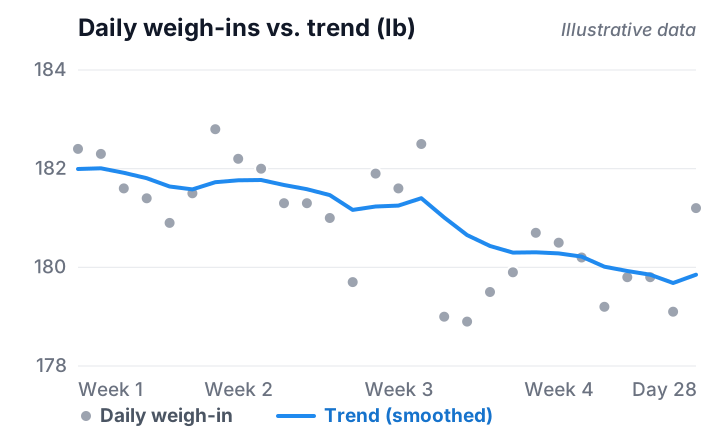
The chart uses made-up data, but it looks like plenty of real weight logs. The dots bounce by 2 or 3 pounds, and one day in week 3 is higher than anything the week before. Read day by day, nothing seems to be happening. The blue line, smoothed from the same numbers, shows a steady loss of about half a pound a week.
To make your own trend more reliable:
- Weigh at the same time, ideally right after waking and using the bathroom.
- Use the same scale on the same hard floor.
- Weigh often enough to have data. Daily works for many people; a few times a week is fine.
- Compare this week's average with last week's, or look at the slope over two to four weeks.
Periscope's Reports tab, for example, draws a smoothed trend line through your weigh-ins and shows your weekly rate of change.
When is a change real?
When the trend keeps moving the same way for two to four weeks. Water shifts reverse within days; fat change shows up as a slope that doesn't come back.
So if your weekly average is up for one week after a holiday, wait. If it's up three weeks running and nothing about your eating or activity changed, it's probably more than water. The same works in reverse: a one-week stall during steady loss is usually noise. A tape measure or progress photos help when the scale is confusing, because water and fat rarely look the same over a month.
When should you see a doctor about weight changes?
Most fluctuations are harmless. Get these checked rather than waiting:
- Fast gain with swelling in your ankles, feet or legs. The NHS says to see a GP if swelling hasn't improved after a few days or is getting worse, and to get urgent advice if it's in one leg only with no obvious cause, or severe or sudden.
- Swelling with shortness of breath, chest tightness or chest pain. That needs emergency care.
- If you have heart failure or kidney disease, follow your care team's weight thresholds.
This is general information, not medical advice. If something feels off, ask a doctor.
Sources
- Schneditz D, et al. Day-to-day variability in euvolemic body mass. Ren Fail. 2023. https://pubmed.ncbi.nlm.nih.gov/37955103/
- Fernández-Elías VE, et al. Relationship between muscle water and glycogen recovery after prolonged exercise in the heat in humans. Eur J Appl Physiol. 2015. https://pubmed.ncbi.nlm.nih.gov/25911631/
- Kreitzman SN, et al. Glycogen storage: illusions of easy weight loss, excessive weight regain, and distortions in estimates of body composition. Am J Clin Nutr. 1992. https://pubmed.ncbi.nlm.nih.gov/1615908/
- NHS. Oedema (swelling). https://www.nhs.uk/conditions/oedema/
- White CP, et al. Fluid retention over the menstrual cycle: 1-year data from the Prospective Ovulation Cohort. Obstet Gynecol Int. 2011. https://pubmed.ncbi.nlm.nih.gov/21845193/
- Haghighizadeh MH, et al. Body weight changes during the menstrual cycle among university students in Ahvaz, Iran. Pak J Biol Sci. 2014. https://pubmed.ncbi.nlm.nih.gov/26035941/
- Clarkson PM, Hubal MJ. Exercise-induced muscle damage in humans. Am J Phys Med Rehabil. 2002. https://pubmed.ncbi.nlm.nih.gov/12409811/
- Orsama AL, et al. Weight rhythms: weight increases during weekends and decreases during weekdays. Obes Facts. 2014. https://pubmed.ncbi.nlm.nih.gov/24504358/
- Turicchi J, et al. Weekly, seasonal and holiday body weight fluctuation patterns among individuals engaged in a European multi-centre behavioural weight loss maintenance intervention. PLoS One. 2020. https://pubmed.ncbi.nlm.nih.gov/32353079/
- Hall KD. What is the required energy deficit per unit weight loss? Int J Obes. 2008. https://pubmed.ncbi.nlm.nih.gov/17848938/
- MedlinePlus. Heart failure: home monitoring. https://medlineplus.gov/ency/patientinstructions/000113.htm
Frequently asked questions
Is it better to weigh in the morning or at night?
Morning, after the bathroom and before eating or drinking. It's the most repeatable moment of the day, so readings are easier to compare.
How long does water weight last?
Usually a few days. Salt-related water settles once your meals go back to normal, glycogen water shifts with how many carbs you eat, and cycle-related bloating tends to ease once a period starts.
Can I gain fat overnight?
Only a tiny amount. Even a very big day of eating adds far less fat than the scale suggests; most of the jump is water and food that clears within days.
Should I stop weighing myself because the numbers jump around?
Not necessarily. Many people find daily weigh-ins calmer once they watch the trend instead of each number. If weighing makes you anxious, weekly or not at all is a perfectly reasonable choice.

Track the trend, not the noise
Periscope is a free weight tracker for iPhone with a smoothed trend line, progress photos and widgets. Your weights and photos stay on your phone.